


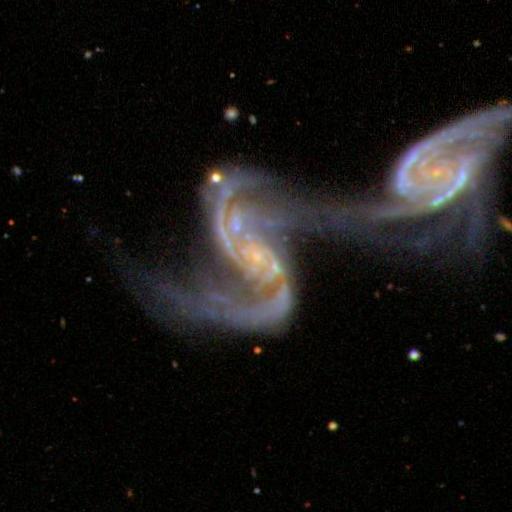
 CJ David went on an online adventure at GalaxyZoo and found these interesting photographs of a barred spiral galaxy, an irregular spiral galaxy, and two merging spiral galaxies while classifying galaxies and looking at the galleries.
Look at the photo with two merging galaxies: What if our very own Milky Way galaxy start to merge or collide with the Andromeda galaxy? Well, the two are actually on a collision course but it won't happen in 3 billion years as estimated by astronomers.
Anyway, looking at these glorious galaxies that no-one has ever laid eyes on before and help out in their discovery is definitely interesting and fun. And getting a sense of the diversity of galaxies and the vastness of the universe is mind-boggling.
GalaxyZoo is a project composed of astronomers from the University of Oxford, the University of Portsmouth and Johns Hopkins University (USA), and Fingerprint Digital Media of Belfast, which harnesses the power of the Internet - and our brain - to classify a million galaxies.
This project was said to be inspired by the Stardust@home project which began August of 2006, in which NASA invited the public to sort through, using a virtual telescope, dust grains obtained by spacecraft mission to Comet Wild-2. This also reminds me of the Seti@home, a distributed computing project which was opened to Netizens in mid-1999 to help Search for Extra-Terrestial Intelligence by analysing radio telescope data using the processing powers of computers that are connected to the Internet.
GalaxyZoo needs human volunteers because the human brain is much better at recognizing patterns than a computer can. Especially patterns that are unusual, the weird and the wonderful. So join in!
Images for personal and educational use courtesy of the Sloan Digital Sky Survey.
Friday, November 30, 2007
Galaxy Geeks Wanted

Wednesday, November 14, 2007
The Milky Way Photographed From Mt. Batulao
 2004.05.31 Mt. Batulao, Nasugbu, Batangas, Philippines
CJ David went on a mountaineering trip to Mt. Batulao. This mountain was an easy trek with interesting rock formations at the peak looking like the ones you would see in a fantasy movie (more about this in another post).
The amazing cloud-free pitch-black sky with all the stars so visible was a huge bonus. I couldn't help but see the patch of the majestic Milky Way filled with colorful stars in the constellation Scorpius and Sagittarius. I shivered at the cold temperature but more because of its beauty.
"I have got to capture this spectacular sight", I thought. And so I grabbed my point-and-shoot digital camera and used its maximum time-exposure setting.
Tada! I was in awe. This was my second heavenly-object photograph which was far much better than the Orion Nebula shot.
I was amazed by this picture of the Milky Way that I thought I had to be in it. Well, here it is: Boolaga!!!
Thursday, October 11, 2007
I Shot the Orion Nebula
 2003.02.01 Noveleta, Cavite, Philippines
Yes, this is the Orion Nebula (or the M42 or NGC 1976) in the constellation Orion.
This was CJ David's first deep-sky object photograph. I was surprised to see this photo when I claimed the pictures from the photolab. This was just a test shot. I even forgot about it. I wasn't really expecting anything good or anything visible to come out of it.
Telescope night-sky photography, especially when shooting deep-sky objects, normally requires: higher ISO to capture light better; a camera-to-telescope adapter/mount and an altitude-azimuth mount so that the telescope and the camera stay focused on the object during long time exposures as heavenly bodies move across the sky due to the Earth's rotation.
How did I do it? With my Minolta 35mm SLR camera, I peeped through the eyepiece of, most probably Engr. Milo Dacanay's new reflecting Newtonian-Dobsonian telescope. I held the camera steady for about 10 to 25 seconds, with its shutter speed set to B, then clicked it.
This shot was taken using only an ISO-400 Kodak S-Gold film with f/3.5 and a 10 to 25-second exposure. The speed of the film and the time exposure wasn't enough to show sharp details of the object but I was relatively astronomically pleased by the result.
This happened during one of the Out-Of-Town Observation Session (OOTOS) of the Philippine Astronomical SocietyHeld in Coastal Bay City, Noveleta, Cavite last February 1st 2003.


